
Fernandes Binns Architects – Architects in Edinburgh, working throughout Central Scotland.
Summary
When a client approached us wanting to build a new house in Fife, her priorities were clear: keep construction and running costs down, build something that would last and was easy to maintain. Here’s how we approached it — and what the result looks like in practice.
Designing a Compact, Cost-Efficient Plan
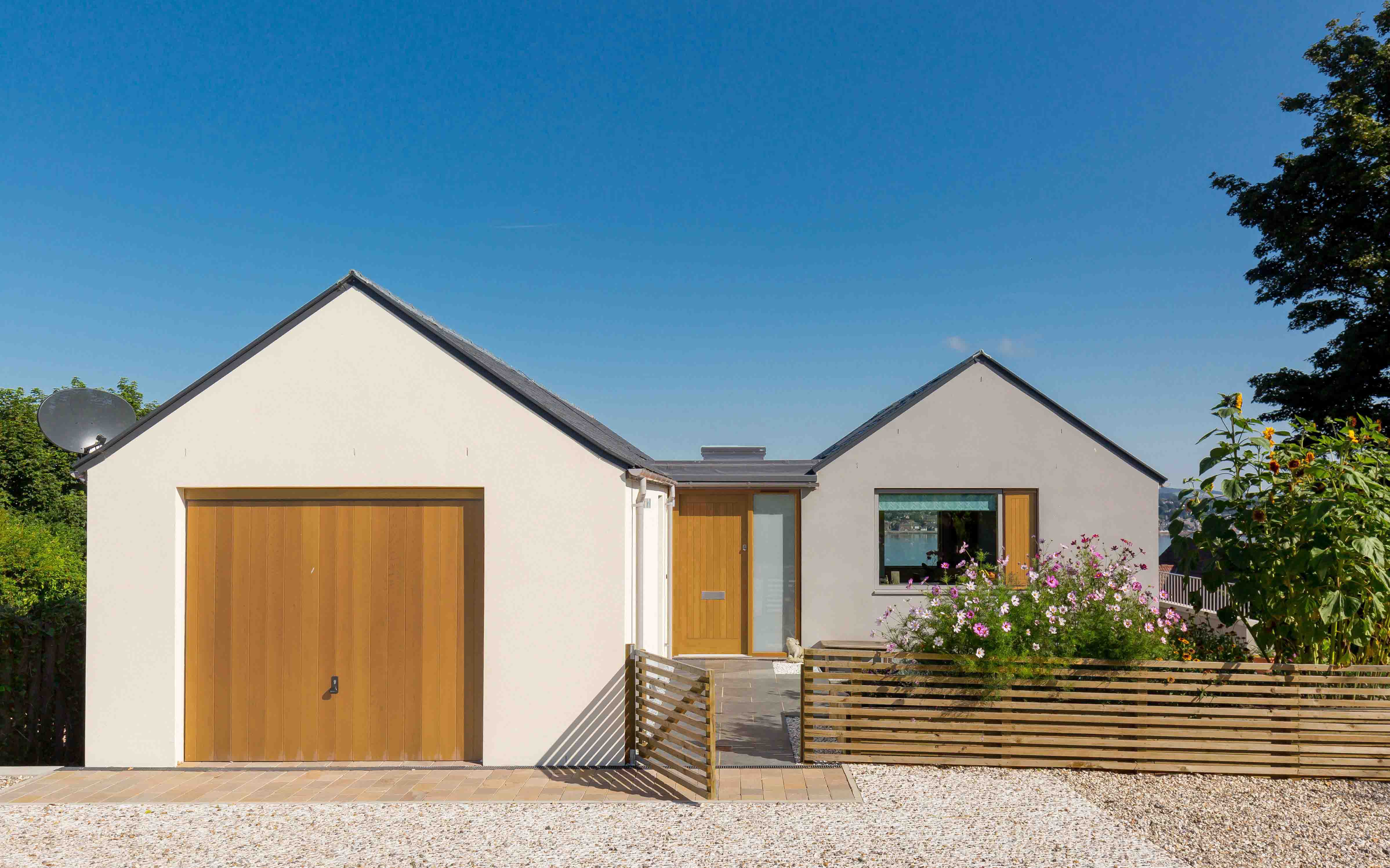
Our Client was relocating to central Scotland, and wanted to build a new energy-efficient home in her daughter’s large garden in Fife. The site was a steeply sloping north facing hillside which presented some design challenges, but there were great views over the Tay Firth that we wanted to make the most of.
In order to minimise the size and cost of the building, we started by making the layout as compact as possible. This included minimising the amount of circulation space, and keeping secondary bedrooms relatively small, while making a generous main living space.

Because of the sloping site, the main entrance is on the upper floor, coming into a hallway with the main living space, bedroom, bathroom, utility room and garage all accessed directly off the bright hallway. Two additional bedrooms and a bathroom are tucked in on the lower floor, which opens onto the back garden. An outside staircase runs along the side of the house to connect the main living space with the front and back gardens, including a south facing ‘sun-trap’ patio at the front.

This compact plan, and cutting the house into the hillside, also allowed for a low surface area to volume ratio, which minimises the ‘building envelope’ (i.e. roof, external walls and floors) area – where heat from the building is lost.


Going Beyond Building Standards: Insulation and Heat Loss
The thermal efficiency of the building envelope was then taken beyond the Building Standards (building code) of the time to further reduce heat loss.
The outside walls and roof are structural timber frames, packed with 140mm or rigid insulation and insulated again inside the frame with an insulated plasterboard. Windows were triple or double glazed and floors were timber framed with rigid insulation above concrete slabs. In simple terms, this means the house holds heat exceptionally well — reducing the demand on the heating system from the outset.

The living spaces and hallway are flooded with natural light to reduce the need for artificial lighting, with windows and rooflights set on different sides (east, south, etc) of the spaces so that they were bright throughout different times of the day.


In addition to checking that the insulation was all well fitted during the building works, we were careful to check the continuity of air tightness membranes and details like insulation of hot water and heating pipework. An air tightness test was carried out as part of the handover process, which is a key step.

Renewable Energy: Heat Pump and Solar Panels
The heating and hot water is all produced from a single Air Source Heat Pump on the side of the house, with a large hot water cylinder in the utility room. The Air Source Heat Pump is run in part by electricity from six photovoltaic panels on the west facing pitch of the roof. The photovoltaic panels are the ‘inline’ type, meaning that they sit on the roof deck, rather than being raised above roofing slates, which can create maintenance difficulties.


We also investigated using a heat recovery extract ventilation system, where incoming fresh air is warmed up by outgoing stale air from bathrooms and kitchens. For this project, this was too costly at the time, but this is something we would look at again on future projects.
The house has been in use for four years now and the current electricity running costs are below £600 a year. This compares to the average running costs of around £2,640 for a house in Scotland (Scottish House Condition Survey 2024).
These costs reflect the net grid import after contribution from the rooftop solar panels, and it is important to highlight that individual results will vary depending on occupancy, usage patterns and energy tariff.
We’ve used similar principles on commercial projects too — read our case study on an energy-efficient office retrofit here.
Thinking About Building in Fife or Central Scotland?
Whether you’re planning a new build home, an extension, or an energy-efficient retrofit across Edinburgh, Fife, or elsewhere in Central Scotland, we’d love to talk through your project! Please get in touch.
Leave a Reply